Two particles are executing simple harmonic motion of the same amplitude A and frequency ꞷ along the x - axis. Their mean position is separated by distance X 0 (X 0 > A). If the maximum separation between them is (X 0 + A), the phase difference between their motion is:


Text Solution
Verified by ExpertsB
When the distance between the particles is maximum, their relative velocity will be zero. This means the particles are at the same distance from from their respective mean positions. Since the maximum distance is  , it means the particles are at half the amplitude position. Also, if one of the particles is left of its mean position, then the other one would be to the right of the mean position.

At  , let
, let  , then
 and the particle is moving along positive
  -axis
-axis

At 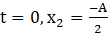
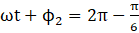 and this particle is also moving towards positive along positive
  -axis
-axis
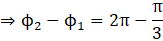
But a phase difference of  is same as a phase difference of
  .
.
So, 
Prepare Smarter with CGP Edu
Get practice questions, solutions, and test series in one place.
Write a Review
Share your experience with this question and solution.
Commentary
Send your comment, doubt, correction, or feedback to admin.
Similar Questions
Explore conceptually related problems